|
|
|
Academic |
|
|
|
Medicine & Anatomy |
|
|
|
Health & Wellness |
|
|
|
Food & Drinks |
|
|
|
Home & Family |
|
|
|
Business & Professional |
|
|
|
Law |
|
|
|
Raw Foods - Vegetarianism |
|
|
|
Languages |
|
|
|
Computers & Technology |
|
|
|
Award Winning Professors Series |
|
|
|
Liberty Legal Forms |
|

|
|
|
ISBN: [B-136-5]
|
| Price: $7.95 |
|
|
|
Superfoods...Your Guide to Understanding the Benefits
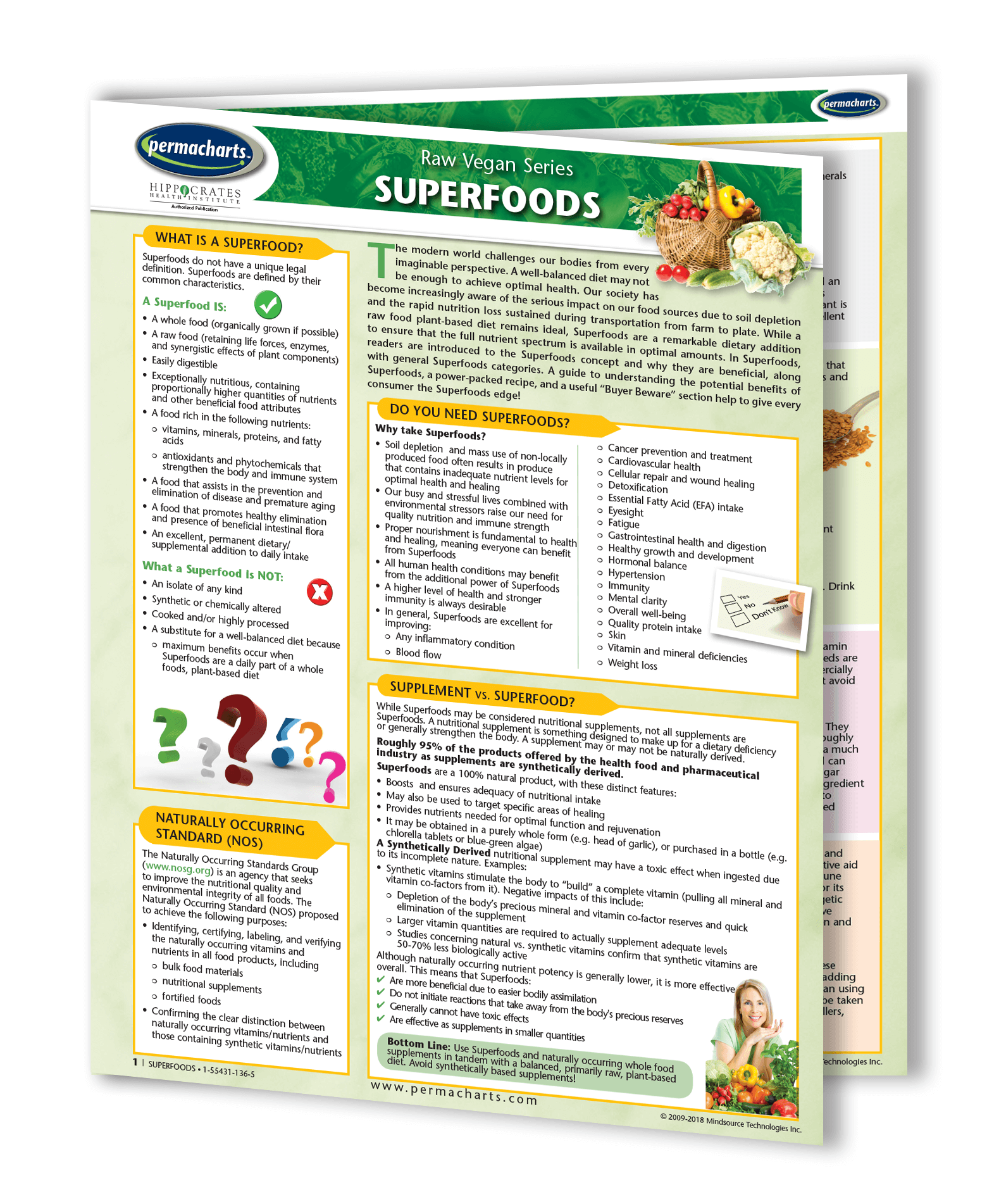
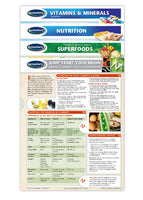
You’ve heard about the benefits of incorporating Superfoods into your diet, but where do you start? With the Raw Foods Superfoods Permachart, of course! In this kitchen-ready guide, you’ll learn what Superfoods are, why you need them how to add Superfoods to your diet, plus, how not to be fooled by imitation Superfoods.
This guide will help you boost your nutrition by teaching you the essentials of Superfoods and how to use them. Start reaping the benefits of a Superfood diet today!
|
LAMINATED GUIDE EXCERPTS AND SUMMARIES
Click the titles to preview some of the
content of this chart.
Online summary: 600 words
Printed version: 1700 words
- What is a Superfood?
- Naturally Occurring Standard (NOS)
- Do you need
Superfoods?
- Supplement vs. Superfood?
- Algae, Pollens, Sprouts &
Young Grasses, Edible Weeds/Local Wild Foods
- Essential Fatty Acids
(EFAs) and/or Mucilage
- Fruit & Berry Seeds
- Vegetables
- Spices
- Seasonings
- Food Components: What they do for you
- Super
Blue-Green Truffles Recipe
- Buyer Beware
Superfoods are a 100% natural product,
with these distinct features:
Boosts and ensures adequacy of
nutritional intake
May also be used to target
specific areas of healing
Provides nutrients needed for
optimal function and rejuvenation
It may be obtained in a purely
whole form (e.g. head of garlic), or purchased in a bottle (e.g.
chlorella tablets or blue-green algae)
In general, Superfoods are excellent
for improving:
Any inflammatory condition
Blood flow
Cancer prevention and treatment
Cardiovascular health
Cellular repair and wound healing
Detoxification
Essential Fatty Acid (EFA) intake
Eyesight
Fatigue
Gastrointestinal health and
digestion
Healthy growth and development
Hormonal balance
Hypertension
Immunity
Mental clarity
Overall well-being
Quality protein intake
Skin
Vitamin and mineral deficiencies
Weight loss
While Superfoods may be considered
nutritional supplements, not all supplements are Superfoods. A
nutritional supplement is something designed to make up for a dietary
deficiency or generally strengthen the body. A supplement may or may
not be naturally derived.
In addition to our super foods list our
chart also tells you common ways to use each ingredient
Algae - Chlorella,
Spirulina, AFA (Aphanizomenon flos-aquae, a blue-green algae)
Pollens - Rich in
antioxidants, the B-Complex vitamins, carotenoids, enzymes,
hormones, rutin, vitamins C and E
Sprouts & Young Grasses
- Rich in antioxidants, phytochemicals, hormones, essential fatty
acids, enzymes, vitamins, and chelated minerals
Edible Weeds/Local Wild Foods
- The best way to learn about local edible species is to attend an
edible weed class in your area. Accurate identification of plants is
essential. Use caution! Each species varies on what part of the
plant is edible, and when/ how to use it. Many edible weeds make
excellent additions to salads and freshly pressed juices.
Foods High in Essential Fatty
Acids (EFAs) and/or Mucilage - Aloe vera, Chia seed and
sprouts, Fenugreek sprouts, Flax seed and sprouts, Hemp seed nut
Fruit & Berry Seeds -
Acai, Acerola, Amla, Camu camu, Goji berries/Wolfberries, Grape
seeds, Mangosteen, Noni, Sprouted berry seeds
Everyday Vegetables, Spices,
and Seasonings - Celery Seed, Garlic, Ginge, Maca, Turmeric
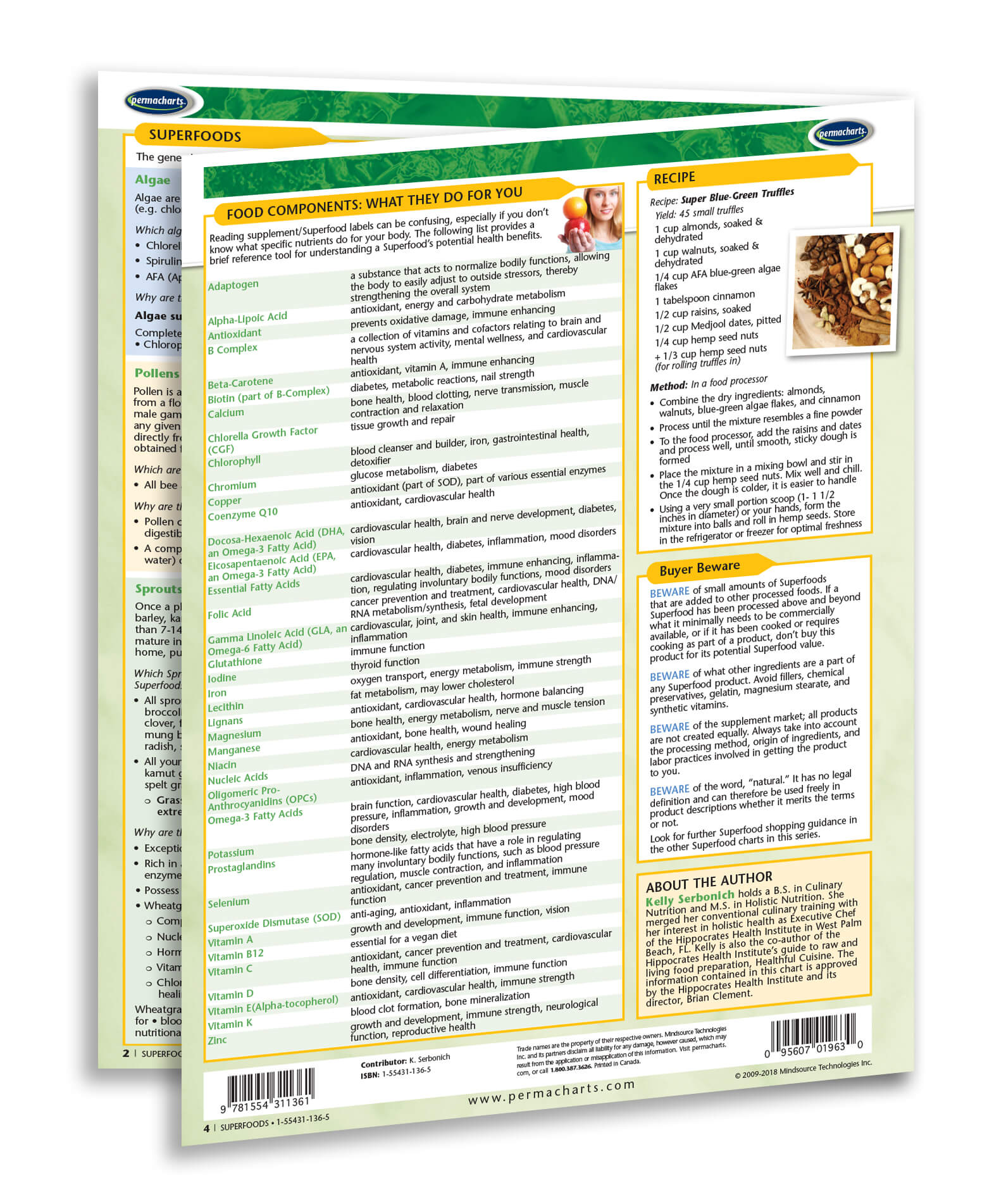
From Adaptogen to Zinc, our full
laminated guide provides you with an instant reference for the
potential health benefits of:
Adaptogen
Alpha-Lipoic Acid
Antioxidant
B Complex
Beta-Carotene
Biotin (part of B-Complex)
Calcium
Chlorella Growth Factor
(CGF)
Chlorophyll
Chromium
Copper
Coenzyme Q10
Docosa-Hexaenoic Acid (DHA,
an Omega-3 Fatty Acid)
Eicosapentaenoic Acid (EPA
an Omega-3 Fatty Acid)
Essential Fatty Acids
Folic Acid
Gamma Linoleic Acid (GLA,
Omega-6 Fatty Acid)
Glutathione
Iodine
Iron
Lecithin
Lignans
Magnesium
Manganese
Niacin
Nucleic Acids
Oligomeric Pro-
Anthrocyanidins (OPCs)
Omega-3 Fatty Acids
Potassium
Prostaglandins
Selenium
Superoxide Dismutase (SOD)
Vitamin A
Vitamin B12
Vitamin C
Vitamin D
Vitamin E(Alpha-tocopherol)
Vitamin K
Zinc
BEWARE of small amounts of Superfoods that are added to other
processed foods. If a Superfood has been processed above and beyond
what it minimally needs to be commercially available, or if it has
been cooked or requires cooking as part of a product, don’t buy
this product for its potential Superfood value.
BEWARE of what other ingredients are a part of any Superfood
product. Avoid fillers, chemical preservatives, gelatin, magnesium
stearate, and synthetic vitamins.
BEWARE of the supplement market; all products are not created
equally. Always take into account the processing method, origin of
ingredients, and labor practices involved in getting the product to
you.
BEWARE of the word, “natural.†It has no legal definition
and can therefore be used freely in product descriptions whether it
merits the terms or not.
- Format: 2 panels, 4 pages
- Size
when folded: 8.5" x 11"
- Size
when open: 11" x 17" flat
- Multi-panel charts are folded using our exclusive Clearkote™
Lay-Flat Hinge
- Laminated both sides with a sealed edge to ensure product is
waterproof and tear proof
- Our Guarantee - Limited
lifetime warranty against peeling and delaminating
About the Author: Kelly Serbonich holds a B.S. in Culinary Nutrition and M.S.in
Holistic Nutrition.She merged her conventional culinary training with
her interest in holistic health as Executive Chef of the Hippocrates
Health Institute in West Palm Beach, FL. Kelly is the co-author of the
Hippocrates Health Institute's guide to raw and living food preparation,
Healthful Cuisine. The information contained in this chart is approved
by the Hippocrates Health Institute's director, Brian Clement.
|
|
|
|
|
|